Containers: Difference between revisions
Jump to navigation
Jump to search
IVSWikiBlue (talk | contribs) Created page with "=Containers= <div class="floating_card"> Containers are used within our software to segment different objects from different users. The objects that can currently be segmente..." |
IVSWikiBlue (talk | contribs) No edit summary |
||
| Line 1: | Line 1: | ||
{{Article - Manual | content = | |||
< | <h1>Introduction</h1> | ||
Containers are used within our software to segment different objects from different users. The objects that can currently be segmented into containers are: User Groups, Templates & Rooms. Containers are often used in higher educational clinical training applications, where more than one department is sharing a single server or server cluster. | Containers are used within our software to segment different objects from different users. The objects that can currently be segmented into containers are: User Groups, Templates & Rooms. Containers are often used in higher educational clinical training applications, where more than one department is sharing a single server or server cluster. | ||
{{Manual lvl 2 | title = Example | content = | |||
An example would be a university putting in an IVS system to record student / patient interactions for both their Psychology and Speech Pathology programs. Containers would allow them do designate 3 levels of administrators. | An example would be a university putting in an IVS system to record student / patient interactions for both their Psychology and Speech Pathology programs. Containers would allow them do designate 3 levels of administrators. | ||
#<b>Global</b>: This level would see all the Users Groups, Users, Templates, Rooms & Cameras on the IVS system. | |||
##<b>Psychology</b>: This level would only see User Groups, Users, Templates, Rooms & Cameras assigned to the Psychology container. | |||
##<b>Speech Pathology</b>: This level would only see User Groups, Users, Templates, Rooms & Cameras assigned to the Speech Pathology container. | |||
There is no limit to how many containers / sub containers can reside within our system. | There is no limit to how many containers / sub containers can reside within our system. | ||
}} | |||
<center>{{img - resize | file = Specifications-10.jpg | width = 700px}}</center> | |||
}} | |||
Revision as of 19:16, 19 March 2025
Introduction
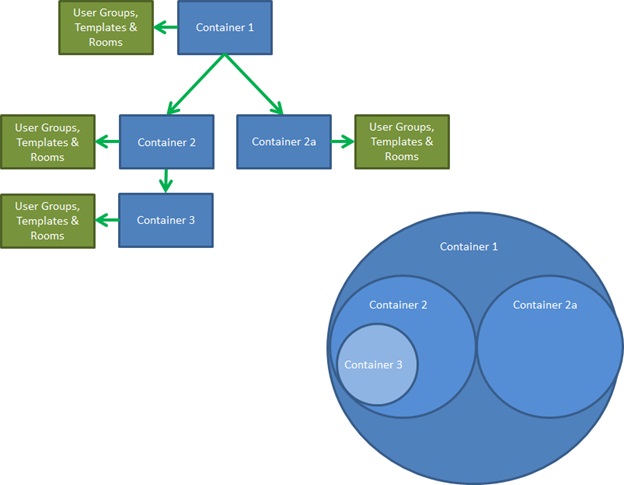
Containers are used within our software to segment different objects from different users. The objects that can currently be segmented into containers are: User Groups, Templates & Rooms. Containers are often used in higher educational clinical training applications, where more than one department is sharing a single server or server cluster.
Example
An example would be a university putting in an IVS system to record student / patient interactions for both their Psychology and Speech Pathology programs. Containers would allow them do designate 3 levels of administrators.
- Global: This level would see all the Users Groups, Users, Templates, Rooms & Cameras on the IVS system.
- Psychology: This level would only see User Groups, Users, Templates, Rooms & Cameras assigned to the Psychology container.
- Speech Pathology: This level would only see User Groups, Users, Templates, Rooms & Cameras assigned to the Speech Pathology container.
There is no limit to how many containers / sub containers can reside within our system.